

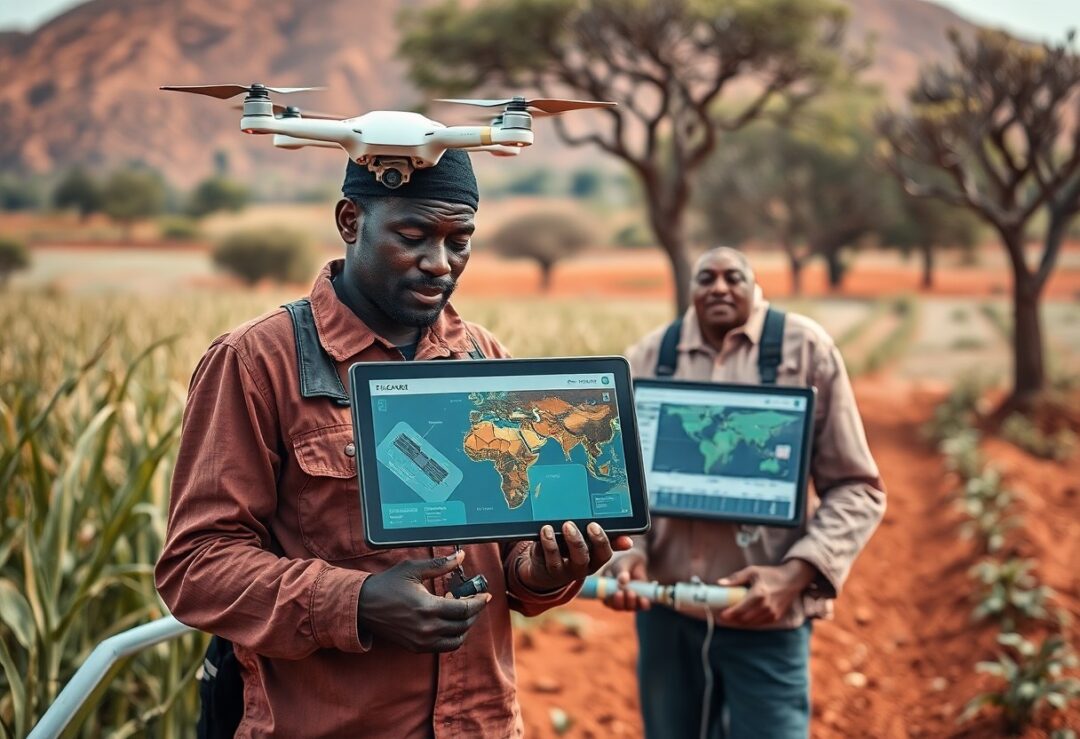
Machine Learning Agriculture in Africa is revolutionising how smallholder farmers and agribusinesses approach crop production, pest management, and resource optimisation across Sub-Saharan farming systems.
Through predictive models, satellite imagery analysis, and IoT sensor networks, farmers can now forecast yields with unprecedented accuracy, detect pests weeks earlier than traditional scouting methods, and optimise irrigation schedules to reduce water consumption by up to 30% whilst maintaining or increasing productivity.
Understanding Machine Learning in African Agriculture
Machine Learning Agriculture in Africa applies sophisticated algorithms to agricultural challenges that have historically limited productivity and food security across the continent.
By ingesting data from multiple sources, such as satellite imagery, drone surveillance, ground-based sensors, weather stations, and historical records, machine learning models identify patterns and predict outcomes at the field scale with remarkable precision.
Core Concepts and Technologies
Machine learning systems train computational models to recognise patterns in both labelled and unlabelled datasets, enabling prediction and classification tasks critical to modern agriculture. Core methodologies include:
Supervised Learning algorithms use labelled training data to predict outcomes such as crop yields, disease probability, or optimal planting dates. Random Forest and XGBoost models have proven particularly effective for agricultural predictions.
Unsupervised Learning identifies hidden patterns in data without pre-defined labels, useful for clustering similar farm plots, identifying anomalous growth patterns, or segmenting fields by productivity zones.
Transfer Learning adapts models trained on global agricultural datasets to local African contexts with limited ground-truth data, dramatically reducing the data requirements for deployment whilst maintaining accuracy above 85-90% in field trials.
Feature Engineering from multispectral satellite imagery—particularly extracting vegetation indices like NDVI (Normalised Difference Vegetation Index) and EVI (Enhanced Vegetation Index)—provides temporal insights into crop phenology and stress indicators.
Why Machine Learning Matters for African Agriculture
With over 60% of Sub-Saharan Africa’s workforce engaged in agriculture and millions of smallholder farms averaging less than one hectare, Machine Learning Agriculture in Africa provides scalable tools to improve decision-making where traditional extension services struggle to reach farmers effectively.
Climate variability, pest pressures, limited access to inputs, and information gaps have historically constrained productivity. Machine learning addresses these challenges through:
- Early warning systems for pest and disease outbreaks
- Field-level yield estimates enabling better market planning
- Irrigation schedules optimised for soil moisture and weather forecasts
- Credit scoring models expanding financial inclusion for smallholders
- Supply chain optimisation reducing post-harvest losses
Field trials across East and Southern Africa report measurable yield gains of 10-30% and input savings of 10-25% where farmers adopt ML-driven recommendations consistently.
Practical Applications Transforming Sub-Saharan Agriculture
Precision Agriculture at Scale
Machine Learning Agriculture in Africa enables precision techniques previously accessible only to large commercial operations.
By combining Sentinel-2 satellite imagery (10-metre resolution, free and open access) with on-farm IoT sensors, farmers can map within-field variability and implement variable-rate fertilisation and irrigation.
Eastern African pilot programmes report 10-25% yield uplifts and 10-20% input savings by applying fertilisers only where NDVI and soil-moisture models indicate deficiencies.
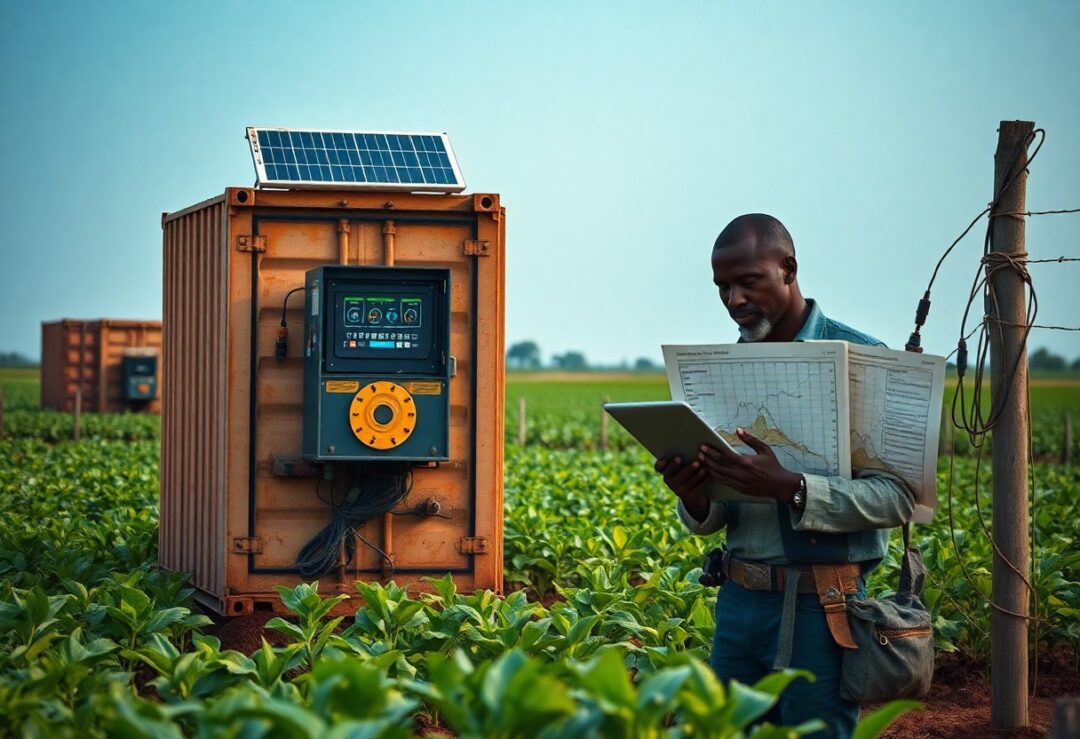
Solar-powered moisture sensors enable these systems to operate reliably in off-grid environments, addressing one of the continent’s persistent infrastructure challenges.
Implementation requires:
- Multi-temporal satellite imagery capture (weekly to bi-weekly)
- Ground-truthing with soil samples and yield measurements
- Model calibration to local soil types and crop varieties
- Integration with existing farm management practices
Disease Detection and Management
Convolutional Neural Network (CNN) models deployed on Android smartphones enable real-time diagnosis of cassava mosaic virus, banana Xanthomonas wilt, and maize rust from simple leaf photographs. PlantVillage Nuru, developed by Penn State University, exemplifies this approach with models trained on tens of thousands of labelled images.
Field trials in Kenya and Tanzania demonstrated diagnostic accuracy exceeding 90%, reducing incorrect treatment rates by approximately 40% compared to manual scouting.
When combined with short-term weather forecasts, these systems issue early warnings days to weeks before outbreaks become visible to human observers.
Technical implementation involves:
- CNN architectures (ResNet, MobileNet) optimised for mobile deployment
- TensorFlow Lite for on-device inference avoiding connectivity requirements
- Active learning loops incorporating farmer-submitted images for continuous model improvement
- Integration with CHIRPS rainfall data and Sentinel time-series for outbreak forecasting
- Validation by extension agents before wide dissemination
<div style=”background-color: #f3f3f3; padding: 20px; border-left: 4px solid #2563eb; margin: 25px 0;”>
🌾 Essential Tools for Agricultural Data Management
- Tresorit Secure Storage – End-to-end encrypted cloud storage protecting sensitive farm data, yield records, and proprietary ML models.
- iDrive Business Backup – Comprehensive backup solution safeguarding agricultural datasets, satellite imagery archives, and field sensor data.
- BlackboxAI – AI-powered development assistant accelerating the creation of custom agricultural ML applications.
- MRPeasy Manufacturing ERP – Production planning software with AI capabilities ideal for agricultural processing and supply chain management.
- 1Password Business – Secure credential management for agritech teams accessing multiple platforms, sensors, and cloud services.
- Bitdefender GravityZone – Enterprise cybersecurity protecting IoT sensor networks and agricultural data platforms from threats.
- Zonka Feedback – Customer feedback platform with AI analytics for agribusinesses measuring farmer satisfaction and adoption.
- Trainual – Document best practices for implementing ML agriculture systems, ensuring consistent deployment across teams. </div>
Data-Driven Yield Forecasting
Combining Sentinel-2 10-metre imagery, daily weather records, and local yield surveys, Machine Learning Agriculture in Africa enables Random Forest, XGBoost, or LSTM (Long Short-Term Memory) models to forecast crop yields 1-3 months before harvest with remarkable accuracy.
Feature sets typically incorporate:
- NDVI and EVI time-series tracking vegetative growth
- Cumulative rainfall and temperature profiles
- Soil moisture estimates from radar (Sentinel-1 SAR)
- Phenological metrics identifying critical growth stages
These field-scale forecasts enable farmers to time harvests optimally, negotiate forward contracts with buyers, and guide input suppliers with greater confidence than relying on historical averages. The Food and Agriculture Organisation (FAO) documents successful scaling approaches in multiple Sub-Saharan countries.
Resource Optimisation and Efficiency
Machine learning optimises irrigation, fertiliser application, and pesticide timing by analysing soil-moisture probe data, satellite-derived evapotranspiration estimates, and short-term weather forecasts.
Reinforcement learning controllers combined with gradient-boosted models report 20-30% reductions in water usage whilst maintaining or increasing yields.
Operational deployment involves:
- Low-power LoRaWAN or NB-IoT soil sensors transmitting hourly measurements
- Fusion of telemetry with Sentinel-derived indices (NDVI, ET)
- AutoML pipelines retraining weekly during growing seasons
- Algorithms predicting soil water deficit and nutrient demand
- Output as pump control commands or variable-rate prescriptions via SMS
Local calibration using representative field samples preserves accuracy across diverse soil types and cropping systems. This approach has proven particularly valuable in digital agriculture initiatives across Kenya, Ghana, and Tanzania.
Proven Impact: Case Studies from Across Africa
PlantVillage Nuru – Kenya
Scale: Approximately 1,200 smallholder farmers (2018-2019 pilot)
Technology: CNN-based disease diagnosis via smartphone cameras
Results: Diagnostic accuracy exceeding 90%, reducing incorrect treatment rates by an estimated 40%
Impact: Earlier intervention enabling crop salvage before total loss
Aerobotics – South Africa
Scale: Tens of thousands of hectares across commercial orchards
Technology: Combined drone and satellite imagery with per-tree ML analytics
Results: 10-15% yield uplift, pest detection 2-3 weeks earlier than manual scouting
Impact: Targeted spraying efficiency improvements reducing chemical usage
Hello Tractor – East Africa
Scale: Thousands of tractors across regional networks
Technology: Telematics and predictive scheduling algorithms
Results: ~25% increase in tillage access, ~30% improvement in rental utilisation
Impact: Reduced idle time, expanded mechanisation access for smallholders
One Acre Fund – Regional
Scale: 1.2-1.5 million farmers across multiple countries
Technology: Predictive models for input delivery and credit scoring
Results: 20-30% maize yield increases where digital recommendations followed
Impact: Improved food security and income for participating households
Twiga Foods – Kenya
Scale: 2,000+ vendors, thousands of smallholder suppliers
Technology: Data-driven logistics and demand forecasting
Results: ~20% reduction in post-harvest spoilage, shortened delivery times
Impact: Increased farmer returns per crate, improved market access
Overcoming Barriers to Adoption
Data Accessibility and Quality Challenges
Machine Learning Agriculture in Africa confronts persistent data constraints. Whilst Sentinel-2 (10-metre) and Landsat (30-metre) provide reliable baseline imagery at no cost, labelled field samples typically number in hundreds or low thousands per study.
Intercropping practices and smallholder plots under one hectare complicate labelling and reduce model generalisability.
Effective strategies include:
- Strategic sampling prioritising diverse agroecological zones
- Transfer learning from global datasets (ImageNet, PlantVillage)
- Active learning identifying the most informative samples for labelling
- Crowdsourced validation through farmer networks
- Integration of multiple data sources (satellite, weather, mobile surveys)
Infrastructure and Connectivity Gaps
Rural electrification remains below 50% across much of Sub-Saharan Africa, mobile broadband coverage is inconsistent, and affordable IoT sensors are limited.
These constraints make real-time telemetry, frequent model retraining, and scalable deployments operationally challenging.
Mitigation approaches successful in field deployments include:
Solar-Powered Infrastructure: 5-20 watt solar modules maintain sensor nodes and edge computing devices in off-grid environments, providing reliable operation throughout growing seasons.
Edge Computing: On-device inference using TensorFlow Lite or ONNX Runtime reduces bandwidth requirements by approximately an order of magnitude compared to cloud-based processing.
Low-Power Wide-Area Networks: LoRaWAN and NB-IoT extend communication range whilst minimising power consumption, enabling battery-powered sensors to operate for months between charges.
Hybrid Architectures: Combining local processing for time-critical decisions with periodic cloud synchronisation for model updates balances performance with connectivity constraints.
Building Local Technical Capacity
The shortage of data scientists, ML engineers, and trained extension workers limits deployment velocity. African universities and technical institutes are expanding agricultural informatics programmes, but demand significantly exceeds supply.
Successful capacity-building strategies include:
- Partnerships with CGIAR research centres providing technical training
- Vendor-led certification programmes (Google, Microsoft, AWS)
- Hackathons and competitions (Zindi) connecting talent to real datasets
- Embedded technical advisors during initial deployments
- Train-the-trainer models scaling knowledge transfer
Emerging Trends Shaping the Future
Edge AI and TinyML
The deployment of inference capabilities directly on low-power devices, including LoRa sensors and Raspberry Pi-class computers—reduces latency and data costs whilst enabling offline operation.
TinyML frameworks allow complex models to run on microcontrollers consuming less than one watt, making sophisticated analytics feasible in resource-constrained environments.
Multi-Modal Satellite Data
Sentinel-2’s 10-metre multispectral imagery provides reliable cloud-free coverage through optical sensors, whilst Sentinel-1 Synthetic Aperture Radar (SAR) penetrates cloud cover for all-weather monitoring.
The combination enables continuous field monitoring even during rainy seasons, previously a significant limitation in tropical regions.
The European Space Agency’s Copernicus programme provides this data freely, democratising access to previously expensive satellite imagery.
Blockchain for Agricultural Traceability
Pilot programmes integrate ML-based quality assessment with blockchain-verified supply chains, enabling premium pricing for certified produce whilst reducing fraud. Smart contracts automatically release payments when ML systems verify delivery quality and quantity.
Autonomous Agricultural Robotics
High-value crop operations in South Africa and Kenya are piloting ML-powered robotic harvesters and precision weeders. Whilst currently limited to commercial farms, declining costs suggest potential for cooperative-shared equipment serving smallholder clusters within 5-10 years.
5G Network Expansion
The rollout of 5G infrastructure across African markets reduces latency for real-time applications including autonomous vehicle navigation, augmented reality extension services, and responsive irrigation control. This enhanced connectivity infrastructure will accelerate adoption of bandwidth-intensive ML applications.
Strategic Implementation for African Agriculture
Co-Design with Farming Communities
Successful Machine Learning Agriculture in Africa initiatives prioritise participatory design, engaging farmers and extension agents from project inception.
This approach ensures models address genuine operational constraints, outputs align with farmer decision-making processes, and recommendations integrate with existing agricultural calendars.
Implementation best practices include:
- Structured interviews identifying current pain points
- Iterative prototyping with feedback loops
- Local language interfaces and visual communication
- Integration with trusted institutions (cooperatives, input suppliers)
- Transparent explanation of model recommendations
Measuring Impact with Rigorous KPIs
Projects should establish clear, measurable success criteria before deployment:
- Yield change (percentage increase/decrease)
- Input cost savings (absolute and percentage)
- Time savings per hectare
- Adoption and retention rates
- Revenue impact per farmer
- Return on investment timelines
Randomised controlled trials (RCTs) provide the most robust evidence, though well-designed quasi-experimental approaches can demonstrate impact when RCTs are impractical.
Sustainable Business Models
Successful scaling requires financially viable models beyond donor funding:
Subscription Analytics: Monthly fees for advisory services (often $2-5 per farmer per season)
Commission-Based: Percentage of increased revenue or input savings
Bundled Services: ML tools packaged with input supply, insurance, or off-take agreements
Freemium Models: Basic services free, premium features subscription-based
Data Monetisation: Aggregated, anonymised insights sold to researchers or input manufacturers
Ensuring Equity and Inclusion
Machine Learning Agriculture in Africa must address equity concerns proactively:
- Include women farmers in training data collection and testing
- Audit models for bias against marginalised groups
- Establish clear data ownership and consent protocols
- Provide offline-capable tools for low-connectivity areas
- Design affordable pricing accessible to resource-poor farmers
- Support in multiple indigenous languages beyond colonial languages
🔐 Secure Your Agricultural Technology Infrastructure
- Tenable Vulnerability Management – Proactive security for agricultural IoT networks, protecting sensor data from cyber threats.
- Tresorit Business – Zero-knowledge encryption safeguarding proprietary agricultural datasets and ML models.
- Auvik Network Monitoring – Real-time visibility and management for agritech infrastructure ensuring sensor network uptime.
- Plesk Cloud Hosting – Managed hosting platform for deploying agricultural ML applications with minimal DevOps overhead.
- EasyDMARC Email Security – Protect farmer communications and advisory services from phishing and email-based attacks.
- CloudTalk AI Call Centre – AI-enhanced telephony for farmer helplines and extension service delivery.
- KrispCall Cloud Telephony – Reliable voice communication infrastructure for agricultural advisory services.
- CyberUpgrade Security Training – Cybersecurity awareness training for agritech teams handling sensitive farmer data.
- Foxit PDF Solutions – Professional PDF tools for creating farmer guides, training materials, and advisory reports.
- Passpack Password Management – Team password management for organisations managing multiple agricultural platforms and services.
Partnerships Accelerating Innovation
Public-private collaborations represent critical accelerators for Machine Learning Agriculture in Africa. CGIAR research centres, national agricultural research institutes, universities, donor agencies, and agritech startups must align around shared objectives with clear governance frameworks.
Effective partnership structures define:
- Data sharing agreements protecting farmer privacy
- Intellectual property arrangements ensuring equitable benefit distribution
- Technical roles and responsibilities across partners
- 6-12 month pilot timelines with concrete milestones
- Scaling pathways contingent on demonstrated impact
- Revenue-sharing or cost-recovery mechanisms
Platforms including Zindi crowdsource modelling talent across Africa, connecting data scientists to agricultural challenges whilst building local capacity.
Regional consortiums standardise data formats and extension workflows, reducing duplication and accelerating deployment.
Addressing Ethical Considerations
Responsible Machine Learning Agriculture in Africa deployment requires attention to:
Data Sovereignty: Farmers should retain ownership of their data with explicit consent required for commercial use. Aggregated, anonymised data can support research whilst protecting individual privacy.
Algorithmic Transparency: Models making high-stakes recommendations (credit decisions, insurance payouts) require explainability enabling farmers and extension workers to understand reasoning.
Bias Mitigation: Regular audits should identify discriminatory patterns, particularly concerning gender, ethnicity, land tenure status, or geographic location.
Human Oversight: Critical decisions affecting farmer livelihoods should preserve human agency rather than defaulting to full automation.
Benefit Distribution: Economic value generated through improved productivity should flow equitably to farming communities, not concentrate exclusively among technology providers.
The Path Forward
Machine Learning Agriculture in Africa has transitioned from experimental pilots to operational deployments demonstrating measurable impact across yield improvement, cost reduction, and risk mitigation.
The convergence of free satellite data, declining sensor costs, expanding mobile networks, and growing local technical capacity creates favourable conditions for continued acceleration.
Success factors for organisations entering this space include:
- Focus on High-Impact Use Cases: Prioritise applications delivering 6-12 month ROI with measurable farmer benefits
- Invest in Data Infrastructure: Build robust pipelines for collection, validation, storage, and governance
- Adopt Participatory Design: Co-create solutions with farming communities ensuring practical relevance
- Plan for Infrastructure Constraints: Design for intermittent connectivity and limited power availability
- Build Local Partnerships: Collaborate with extension services, cooperatives, and input suppliers for last-mile delivery
- Measure Rigorously: Implement robust monitoring and evaluation frameworks tracking adoption and outcomes
- Address Equity Proactively: Ensure technologies serve smallholders and marginalised farmers, not only commercial operations
- Commit to Ethical Standards: Establish data governance, algorithmic transparency, and benefit-sharing frameworks
The challenges remain substantial: data scarcity, connectivity gaps, capacity constraints, and affordability barriers require sustained innovation and investment.
However, the demonstrated impact of existing deployments, declining technology costs, and growing ecosystem maturity suggest Machine Learning Agriculture in Africa will play an increasingly central role in addressing food security, climate adaptation, and rural development objectives across the continent.
For agribusinesses, research institutions, and technology providers, the opportunity is clear: develop solutions addressing genuine farmer needs, deploy with appropriate technical and social safeguards, measure impact rigorously, and scale through sustainable business models and strategic partnerships.
The transformation of African agriculture through intelligent, data-driven systems is not a distant possibility, it is happening now, farm by farm, across the continent.
Conclusion
The applications of Machine Learning Agriculture in Africa demonstrate that sophisticated predictive analytics, automated diagnostics, and optimised resource management are no longer exclusively the domain of large commercial operations in developed economies.
Smallholder farmers across Sub-Saharan Africa are leveraging satellite imagery, mobile-based diagnostics, IoT sensors, and cloud-based ML models to make better-informed decisions about planting, input application, pest management, and harvest timing.
The case studies presented, from PlantVillage Nuru’s disease detection in Kenya to Aerobotics’ precision agriculture in South African orchards, Hello Tractor’s mechanisation platform across East Africa, and One Acre Fund’s impact on over a million farmers, provide concrete evidence that Machine Learning Agriculture in Africa delivers measurable value when implemented thoughtfully with farmer needs central to design.
Challenges persist around data availability, infrastructure reliability, technical capacity, and equitable access. However, the trajectory is unmistakable: declining sensor costs, expanding satellite coverage, improving connectivity, growing local expertise, and proven ROI are accelerating adoption.
Agricultural stakeholders who invest now in building data foundations, forging strategic partnerships, and developing contextually appropriate ML solutions will shape the future of food production across the continent.
The question for agricultural enterprises, research institutions, and development organisations is not whether to engage with Machine Learning Agriculture in Africa, but how to do so effectively, ethically, and at scale. The tools exist, the evidence is established, and the opportunity to transform African agriculture through intelligent systems is immediate.
🚀 Transform Your Agritech Operations
- BlackboxAI – AI development platform | Tresorit – Encrypted storage | Bitdefender – Cybersecurity
Frequently Asked Questions
What is “Machine Learning Agriculture Africa” and how is it being used in Sub-Saharan farming?
Machine Learning Agriculture Africa applies computational algorithms to agricultural challenges, using satellite imagery, drone data, IoT sensors, and historical records to predict yields, detect pests, optimise irrigation, and improve market access.
Common applications include CNN-based disease diagnosis from smartphone photos, satellite-derived yield forecasting 1-3 months before harvest, and reinforcement learning for irrigation scheduling reducing water use by 20-30%.
Which specific ML applications deliver the biggest benefits for smallholder farmers?
High-impact applications include: (1) disease detection from images reducing crop losses 20-40%; (2) yield forecasting enabling better market planning; (3) precision irrigation and fertiliser recommendations cutting input costs 10-25%; (4) ML-based credit scoring expanding finance access; and (5) market-price forecasting reducing post-harvest waste.
Pilots across Kenya, Ghana, and Tanzania demonstrate 10-30% yield gains where recommendations are followed consistently.
What data and infrastructure are required, and what are the main deployment barriers?
Essential inputs include labelled training data (field surveys, annotated images), time-series satellite data (Sentinel-2, Landsat), weather records, and IoT sensor streams. Infrastructure needs encompass mobile connectivity, edge-capable devices, and cloud services.
Key barriers are limited labelled datasets, intermittent connectivity, technical capacity gaps, hardware affordability, and model generalisation across small heterogeneous plots. Solutions include transfer learning, edge computing, and local capacity building.
How can projects ensure ML tools are practical and adopted by smallholder communities?
Successful deployment co-designs models with farmers and extension agents, pilots with measurable KPIs (yield change, cost savings, adoption rates), uses on-device inference for intermittent networks, provides local-language outputs, integrates with trusted institutions (cooperatives, suppliers), and implements affordable pricing.
Address equity by including women and marginalised groups in testing, auditing for bias, and safeguarding data ownership.
What technical strategies help ML models perform well across diverse African farming systems?
Effective approaches include transfer learning to fine-tune global models on local datasets, federated learning preserving data privacy, active learning prioritising informative sample labelling, model compression for edge deployment, ensemble methods combining satellite and ground data, and explainable AI enabling extension worker interpretation.
Regular retraining with seasonal data and local validation trials maintain model relevance and accuracy above 85%.
Stay informed about agricultural technology developments across Africa by following AfricanITNews for insights on sustainable farming innovations, digital agriculture initiatives, and emerging technologies transforming the continent’s food systems.