

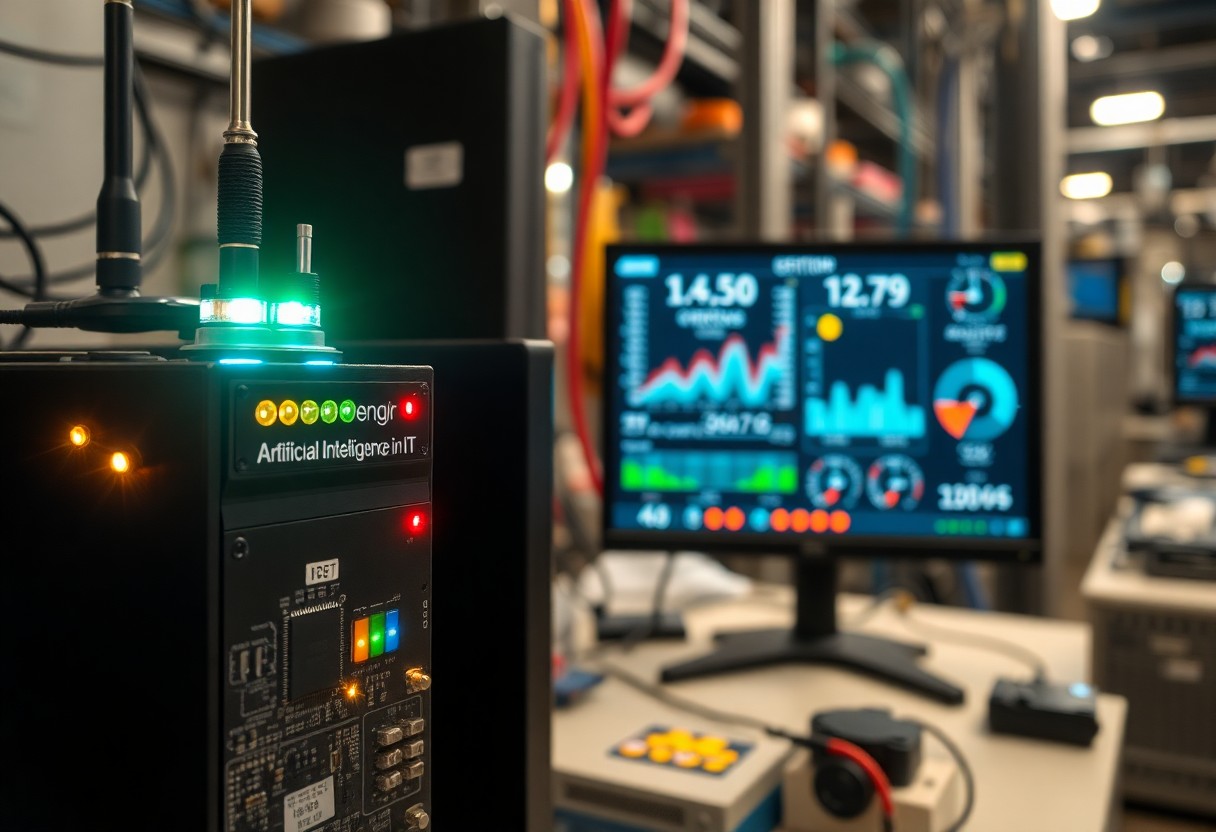
There’s a convergence of Artificial Intelligence in IoT and edge computing that lets you process sensor data at the source, enabling your devices to detect anomalies, act autonomously, and deliver low-latency insights for faster decisions. This blend reduces bandwidth and privacy exposure while scaling predictive maintenance, adaptive automation, and contextual analytics so your operations become more responsive and efficient in real environments.
Understanding Artificial Intelligence in IoT
You see AI in IoT as embedded machine learning and analytics that transform raw sensor streams into immediate insights at the edge and cloud. For example, real-time anomaly detection on vibration sensors can identify bearing wear minutes before failure, while camera-based inference at gateways reduces cloud round-trips, enabling millisecond-level responses and lowering operational costs.
Definition and Overview
You should view the definition as ML models deployed on devices, gateways, or cloud that perform perception, prediction and decision tasks. Algorithms range from lightweight decision trees and regression for sensor fusion to CNNs and RNNs for vision and time-series; deployed frameworks include TensorFlow Lite and ONNX Runtime for quantized models running with constrained compute and power budgets.
Importance of AI in IoT Applications
You gain real-time situational awareness, lower operational costs, and improved safety when AI filters, prioritizes, and acts on sensor data locally. In manufacturing, predictive models cut unplanned downtime and in retail, edge vision enables cashier-less checkout; in healthcare, on-device inference preserves privacy while delivering immediate alerts to clinicians.
You can implement these benefits using platforms like AWS IoT Greengrass, Azure IoT Edge, or NVIDIA Jetson for on-device inference. Practical deployments report telemetry volume reductions up to 90% by filtering at the edge, latency dropping to single-digit milliseconds for control loops, and faster mean-time-to-detect-letting your teams act on faults before they escalate.
The Role of Edge Computing
Edge computing shifts processing to gateways and devices so you get decisions in milliseconds rather than seconds; for example, a factory camera running inference at the edge can flag defects in under 50 ms and cut cloud traffic by up to 90%. This lets your systems act locally on time-sensitive events, preserves bandwidth for aggregated summaries, and keeps operations resilient when WAN links are congested or intermittent.
What is Edge Computing?
Edge computing places compute, storage, and analytics physically close to sensors so you process data locally instead of streaming raw telemetry to the cloud. Platforms like AWS Greengrass, Azure IoT Edge, and NVIDIA Jetson run containerized workloads and TensorFlow Lite models on-site, enabling you to filter, aggregate, and perform ML inference at the source – for instance, a camera classifying anomalies before sending only metadata upstream.
Advantages of Edge Computing in IoT
You gain lower latency, reduced bandwidth costs, stronger data privacy, and higher availability when you process at the edge. Latency can drop from hundreds of milliseconds to single-digit milliseconds and bandwidth usage often falls by 70% or more because you transmit events instead of raw streams. These benefits matter in autonomous vehicles, industrial automation, and live video analytics where split-second decisions determine outcomes.
Delving deeper, edge enables use cases like predictive maintenance where vibration analysis runs locally to detect bearing faults within seconds, or smart retail where cameras trigger real-time promotions without cloud round-trips. In one manufacturing deployment, edge analytics reduced cloud-bound data by ~90% and accelerated fault detection by ~80%, and telco operators are likewise deploying edge for 5G network functions to meet strict SLA latency and throughput targets.
Real-Time Intelligence Explained
Achieving real-time intelligence means your systems sense, infer, and act within tight time windows-often sub-100 ms for many industrial and consumer scenarios. Edge AI performs on-device inference to meet these latency targets, reducing cloud hops and conserving bandwidth; for example, a 30 fps camera pipeline needs per-frame inference under ~33 ms to avoid backlog. You rely on deterministic processing and stream-aware models to keep decision loops fast and predictable.
Definition of Real-Time Intelligence
Real-time intelligence combines continuous sensor input, low-latency inference, and immediate actuation so your system closes the loop without human delay. Metrics you track include latency (target ranges:
Use Cases in Various Industries
In manufacturing, predictive maintenance uses vibration and temperature sensors to detect faults seconds before failure, cutting downtime by 10-30%; in healthcare, continuous bedside monitoring flags arrhythmias within seconds for faster intervention; in transportation, ADAS and autonomous stacks require
For example, a factory line sampling vibration at 5 kHz can feed lightweight CNN classifiers on an industrial gateway to spot bearing anomalies within 2-5 seconds, allowing automated tool shutdown and avoiding multi-hour outages. In hospitals, edge AI analyzing ECG streams reduces clinician alert fatigue by filtering false positives and surfacing high-confidence events in under 10 seconds. Transit agencies run video analytics at junctions to adapt signal timing in real time, lowering average vehicle delay by measurable percentages during peak hours. These deployments show how you can tune sensor rates, model complexity, and edge hardware to meet specific latency, accuracy, and cost targets for each use case.
Integration of AI and Edge Computing
Integrating AI at the edge gives you real-time decisions while reducing cloud dependency; devices from NVIDIA Jetson to Google Coral run optimized models locally to achieve inference latencies under 10 ms. You can explore architectural patterns and benchmark results in this paper on AI in Edge Computing and IoT, which documents throughput improvements and bandwidth savings in practical deployments.
How AI Enhances Edge Computing
By running compressed models and using techniques like 8‑bit quantization and pruning, you can reduce model size by roughly 4x and perform inference on microcontrollers or edge GPUs. You deploy federated learning to update models across devices without moving raw data, and you combine local rule engines with on-device ML so time-sensitive actions execute in milliseconds while complex analytics run upstream.
Impact on Data Processing and Analysis
Edge AI enables you to filter, aggregate, and label data at the source, often reducing transmitted volumes dramatically; in video analytics pipelines you may cut bandwidth by as much as 90% by sending only event metadata. You gain sub-second anomaly detection and stronger privacy controls because raw sensor streams remain on your device instead of the cloud.
Case studies show how this translates: deploying edge analytics across a production line of hundreds of sensors can detect vibration anomalies within ~100 ms, enabling predictive maintenance that studies report can reduce unplanned downtime by about 30% and lower cloud storage needs by roughly 70-80%, letting you focus cloud resources on high-value insights rather than raw telemetry.
Challenges and Considerations
You must balance latency, bandwidth and compliance when pushing intelligence to the edge: real-time use cases often require sub-50 ms responses while keeping costs down and meeting data residency laws. Edge deployments can span hundreds to thousands of nodes, so plan for orchestration, monitoring and secure updates; see A Comprehensive Guide to Real-Time AI at the Edge for practical architectures and case studies.
Security and Privacy Concerns
When you deploy models on-device, attack surface grows: firmware vulnerabilities, unsecured APIs and unencrypted telemetry are common vectors. Implement hardware root-of-trust, TLS, and secure boot; apply least-privilege for agent processes. In practice, using edge-side anonymization and differential privacy can reduce PII exposure while preserving analytics value-important when thousands of devices stream metadata to centralized systems.
Scalability and Resource Management
You need policies that handle heterogeneous hardware-microcontrollers with
For deeper management, adopt orchestration tools (KubeEdge, AWS Greengrass, or custom agents) to push containerized services, perform rolling updates and collect metrics centrally; this lets you detect drift and rollback faulty models. Also use techniques like model distillation, pruning (which can reduce parameters by 50-90% depending on architecture), and hierarchical inference-run a tiny classifier on-device and escalate to a larger model at the gateway only when needed-to stretch resource budgets while maintaining end-to-end SLAs. Monitoring CPU, memory, inference latency and power draw per node will let you set adaptive load-shedding and automated scaling rules.
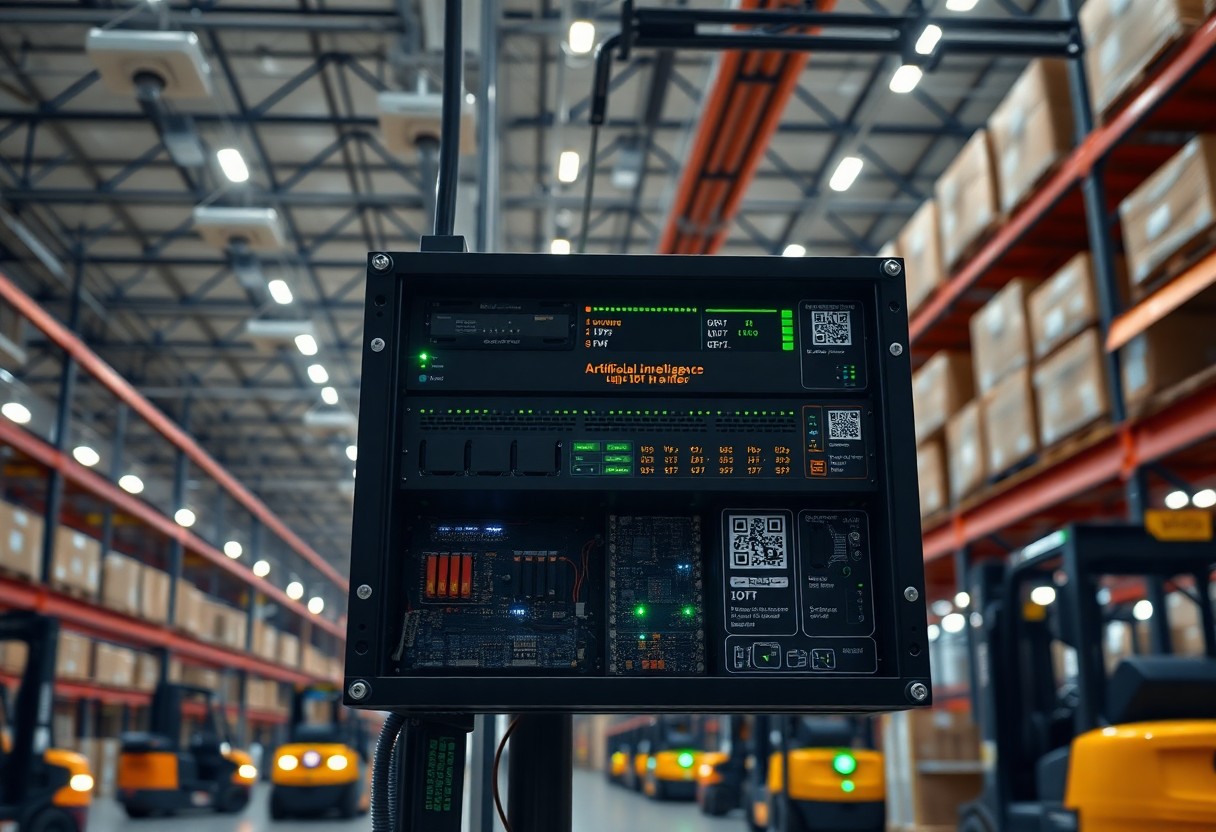
Future Trends in AI and IoT
Emerging Technologies
You will see tinyML pushing inference into microcontrollers with models measured in kilobytes, enabling always-on sensors that use milliwatts of power. Neuromorphic chips like Intel Loihi and event-based cameras are lowering energy per inference for spiking workloads, while 5G URLLC already delivers sub-1 ms latency in tests and 6G research targets sub-ms real-time links. Federated learning (used by Google for Gboard) and secure enclaves let you train models across devices without moving raw data, and digital twins from Siemens and GE scale predictive maintenance across fleets.
Predictions for Future Developments
Over the next 3-5 years, you should expect most latency-sensitive inference to move on-device or to nearby edge nodes, cutting upstream bandwidth by up to 90% in trials and enabling closed-loop control for robotics and autonomous vehicles. Business models will shift toward AI-as-a-service at the edge, and regulation will force standardized privacy-preserving architectures across industries.
Practically, that means you’ll adopt hybrid architectures: lightweight models running on Arm Cortex-M or NVIDIA Jetson at the edge for real-time vision, with heavier retraining in regional clouds. Case studies already show smart factories using digital twins to reduce downtime and telcos deploying MEC to host AI workloads for AR/VR. You should invest in model compression, continuous deployment pipelines for edge models, and telemetry that tracks drift so your fleet-wide updates remain safe and performant. Security will become operational: hardware roots of trust and federated learning will be part of your procurement checklist.
To wrap up
Drawing together, Artificial Intelligence in IoT and edge computing let you process sensor data at the source, enabling real-time decisions, reduced latency, and adaptive automation that enhances operational efficiency and security. You can deploy models on devices, scale insights across networks, and maintain control over data flows to meet performance and compliance demands.
FAQ
Q: What is Artificial Intelligence in IoT and how does edge computing fit into it?
A: Artificial Intelligence in IoT refers to embedding machine learning and inference capabilities into IoT systems so devices can analyze sensor data, detect patterns, and make autonomous decisions. Edge computing places compute and storage close to sensors and actuators-on gateways, edge servers, or the devices themselves-so AI models run locally instead of in the cloud. This combination reduces latency, lowers network bandwidth use by filtering or aggregating data at the source, and enables continuous, real-time responses for time-sensitive applications.
Q: How does combining Artificial Intelligence in IoT with edge computing enable real-time intelligence?
A: Running AI inference at the edge enables near-instant processing of sensor streams, which eliminates round-trip latency to cloud servers. Techniques like model quantization, pruning, and lightweight architectures allow efficient on-device inference. Hardware accelerators (TPUs, NPUs, GPUs) and asynchronous pipelines process data in parallel, while local decision logic and event-driven triggers allow systems to act immediately on anomalies, control loops, or safety overrides. Data pre-processing at the edge also preserves bandwidth and prioritizes only actionable events for cloud analytics.
Q: What real-world use cases show the impact of Artificial Intelligence in IoT and edge computing?
A: Industrial predictive maintenance uses sensor fusion and edge AI to spot equipment anomalies and trigger maintenance before failure. Autonomous vehicles and drones rely on edge AI for perception, object detection, and collision avoidance with millisecond response times. Healthcare wearables process vitals locally to detect arrhythmias or falls in real time and alert providers. Smart retail uses edge vision analytics for inventory tracking and queue management without streaming all video to the cloud. Precision agriculture uses edge AI on distributed sensors and cameras to detect pests, optimize irrigation, and reduce chemical use.
Q: What are the key steps and architectural choices for designing AI-driven IoT edge systems?
A: Start with a clear use case and latency/SLO requirements, then design the data flow and where inference must occur (device, gateway, or edge server). Select sensors and edge hardware that balance compute, power, and cost. Choose model architectures suitable for constrained environments and apply optimization (quantization, pruning, compiling to runtimes like TensorFlow Lite, ONNX Runtime, or vendor SDKs). Implement secure OTA model and firmware updates, telemetry for model performance monitoring, and fallbacks if connectivity or inference fails. Use containerized or orchestrated edge workloads when scaling across sites, and define a cloud-edge integration strategy for batch training, analytics, and long-term storage.
Q: What challenges come with deploying Artificial Intelligence in IoT at the edge and how can they be mitigated?
A: Challenges include limited compute and power budgets, model drift from changing environments, data privacy and compliance, secure update mechanisms, and heterogeneity of edge devices. Mitigations: use model compression and hardware accelerators to meet resource constraints; implement federated learning or periodic retraining pipelines to address model drift; keep sensitive data on-device and transmit only aggregated or anonymized results; use strong authentication, encryption, code signing, and secure boot for updates; standardize runtimes and CI/CD for repeatable deployments; and include explainability and logging to validate decisions and meet regulatory needs.