

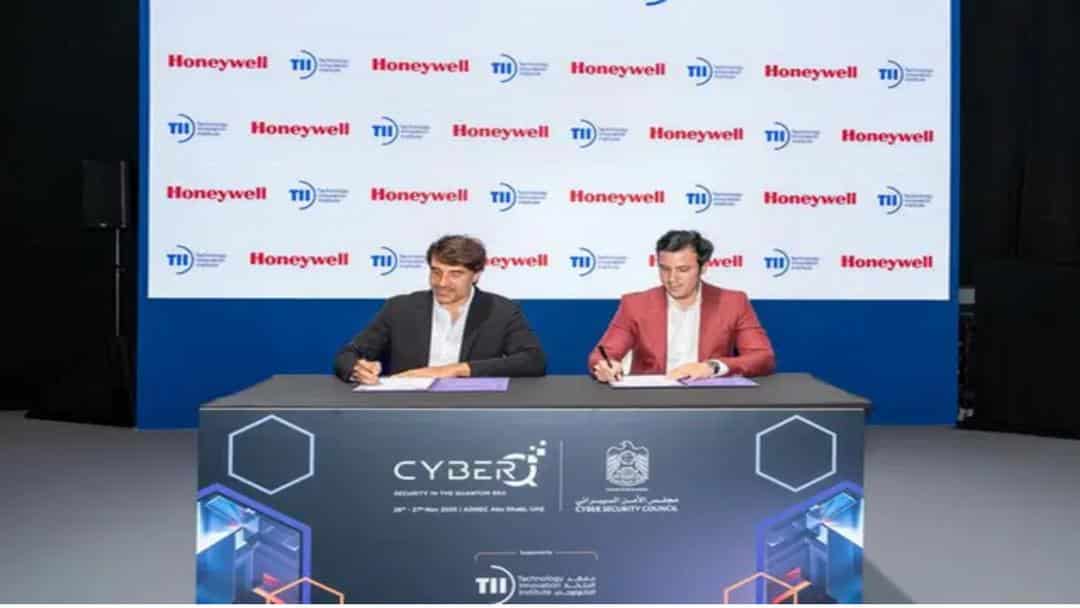
Abu Dhabi’s push for quantum-secure satellite communications gains pace as the Technology Innovation Institute partners with Honeywell to pilot space-to-ground quantum key distribution. The agreement links Honeywell’s QKDSat with TII’s Abu Dhabi Quantum Optical Ground Station for live trials.
The collaboration targets end-to-end key exchange from orbit, validating long-distance links that exceed fibre reach and strengthening quantum-resilient infrastructure for government, defence and commercial users.
The project advances practical deployment by combining space-grade engineering with applied quantum research to move quantum-secure satellite communications from concept to operations.
Quantum-Secure Satellite Communications: What You Need to Know
- TII and Honeywell will trial space-to-ground QKD by integrating QKDSat with ADQOGS to prove scalable, long-distance key exchange beyond fibre limits.
Recommended tools to harden critical communications
- Bitdefender – enterprise-grade endpoint and network protection.
- 1Password – secure secrets management and password governance.
- IDrive – encrypted backup for resilient data recovery.
- Tenable Vulnerability Management – continuous visibility of attack exposure.
- EasyDMARC – stop spoofing with DMARC, SPF and DKIM.
- Tresorit – end-to-end encrypted cloud collaboration.
- Optery – automated personal data removal for executives.
- Auvik – network monitoring and configuration backup.
Inside the TII and Honeywell partnership
The TII Honeywell quantum collaboration aligns space systems expertise with quantum research to accelerate the deployment of quantum-secure satellite communications.
TII provides ADQOGS, a versatile optical ground station for satellite quantum experiments, while Honeywell supplies QKDSat, a purpose-built quantum key distribution satellite platform.
By integrating these assets, the partners will establish and test end-to-end space-to-ground QKD links that interface with terrestrial quantum networks.
The work advances quantum-secure satellite communications toward operational readiness for cross-border, high-assurance use cases.
From laboratory to orbit-ready systems
Turning research into mission capability demands proven space engineering. Honeywell’s track record in secure satellite systems underpins live demonstrations, while TII’s quantum expertise strengthens ground infrastructure and experimental design.
Together, they aim to transition quantum-secure satellite communications from laboratory setups to resilient, orbit-validated performance.
With adversary compute power rising and attack surfaces expanding, quantum-secure satellite communications address long-horizon decryption risks by focusing on trusted execution under real orbital conditions.
How QKD underpins space-to-ground security
QKD uses quantum states of light to generate encryption keys with inherent eavesdropping detection. Any interception introduces a measurable disturbance, signalling compromise.
This physics-based approach makes quantum-secure satellite communications resilient against future cryptanalysis, including quantum-enabled attacks.
In this programme, QKD will be demonstrated along space-to-ground paths to complement terrestrial quantum networks, strengthening defence-in-depth beyond what classical cryptography alone can guarantee.
The role of ADQOGS and QKDSat
ADQOGS, developed and operated by TII, supports satellite-based quantum experiments and precise optical tracking.
Combined with Honeywell’s quantum key distribution satellite platform, the system will validate live key exchange under orbital conditions, a critical step toward quantum-secure satellite communications a global scale.
By overcoming fibre distance limits and infrastructure gaps, the setup targets long-range, low-leakage key delivery unconstrained by terrestrial backbones.
What the leaders said
TII’s chief executive, Dr Najwa Aaraj, said the partnership advances trusted, quantum-secure satellite communications in the UAE and globally by pairing aerospace engineering with quantum research to protect critical information in a quantum-ready future.
Honeywell’s aerospace technologies lead, Lisa Napolitano, outlined how the company’s space heritage will help convert quantum science into real missions, with TII’s collaboration accelerating delivery of trusted, global quantum-secure communications.
Why it matters for critical communications
Organisations face escalating risks from state-aligned intrusion and potential future decryption. By pairing physics-backed key exchange with space coverage, quantum-secure satellite communications mitigate long-term cryptanalytic threats.
Related context includes recent advances in encryption and persistent telecom-targeted espionage: How encryption enhances security; Telecom cyber-espionage targeting.
Across Africa and emerging markets, high-assurance infrastructure aligns with broader connectivity and security agendas. See regional momentum on next‑gen networks in 5G in Africa: 2025, and explore executive risks from credential compromise in phishing-driven cyberattacks.
For strategic context, review the impact of quantum computing on businesses.
Beyond fibre limitations
Fibre-based quantum networks face attenuation and cost barriers over long distances. In contrast, quantum-secure satellite communications extend key delivery across continents and oceans, supporting sovereign resilience where ground infrastructure is sparse or impractical.
Implications for global security and industry
Advantages: Quantum-secure satellite communications can protect diplomatic, defence, financial, and critical infrastructure data with verifiable key integrity and broad geographic reach.
The TII Honeywell quantum collaboration also strengthens the UAE’s role in shaping standards, interoperability, and procurement pathways for trusted global networks.
Constraints: Space missions remain capital-intensive and technically demanding. Atmospheric effects, line‑of‑sight constraints and stringent validation will influence rollout timelines.
Interoperability, supply chain assurance and export controls will determine accessibility and operational integration across jurisdictions.
Secure your stack before you scale
- Passpack – team password management with secure sharing.
- Tresorit Business – encrypted file sharing and compliance.
- Plesk – secure server and application management.
- Tenable Identity Exposure – detect and fix Active Directory risks.
- IDrive – encrypted, immutable backups for ransomware recovery.
- 1Password – enforce strong authentication at scale.
Conclusion
The TII–Honeywell initiative moves quantum-secure satellite communications from theory to field trials by pairing QKDSat with ADQOGS for live, end-to-end key exchange.
The programme directly targets long-distance, high‑trust distribution to support government, security and commercial operations, complementing terrestrial quantum networks and bolstering strategic resilience.
As pilots mature, enterprise adoption will hinge on repeatable performance, certified supply chains and global standards that allow quantum-secure satellite communications to interoperate across borders and sectors.
Questions Worth Answering
What is the goal of the TII and Honeywell partnership?
- To trial end-to-end space‑to‑ground QKD by integrating Honeywell’s QKDSat with TII’s ADQOGS for secure key distribution.
How does QKD improve security?
- QKD generates keys using quantum states; any interception causes detectable disturbances, signalling attempted eavesdropping.
What is ADQOGS?
- A TII-operated quantum optical ground station that supports satellite quantum communication experiments and validations.
What is a quantum key distribution satellite?
- A spacecraft platform, such as Honeywell’s QKDSat, designed to transmit quantum keys securely to ground stations and network nodes.
Who benefits from this capability?
- Government, defence, telecoms, financial services and critical infrastructure operators needing trusted, long‑distance protection of sensitive data.
Will this replace existing networks?
- No. It complements terrestrial networks by extending secure key delivery beyond fibre limits and across large distances.
How does this relate to broader cyber risks?
- It mitigates long-horizon decryption threats and strengthens defence‑in‑depth alongside modern cryptography and operational security controls.
About Technology Innovation Institute (TII)
Technology Innovation Institute is the applied research arm of Abu Dhabi’s Advanced Technology Research Council. It focuses on advancing breakthrough, sovereign technologies.
TII operates the Abu Dhabi Quantum Optical Ground Station (ADQOGS) to enable satellite-based quantum communication trials and secure networking research.
The institute’s mission includes building trusted capabilities that elevate the UAE’s role in next‑generation security innovation and standards.
About Honeywell
Honeywell is a global technology company with deep experience in aerospace systems and secure satellite communications for critical missions.
The company’s QKDSat platform is designed to deliver space-based quantum key distribution for trusted networks.
Honeywell works with leading research partners to translate quantum science into operational, space‑ready capabilities.
About Dr. Najwa Aaraj
Dr Najwa Aaraj is Chief Executive Officer of the Technology Innovation Institute in Abu Dhabi.
She leads advanced research programmes spanning quantum technologies and secure communications infrastructure.
Her focus includes building trusted, globally relevant systems to protect critical information in a quantum-ready future.
Explore more solutions: Blackbox AI, Cloudtalk, LearnWorlds – build, connect and secure operations faster.