

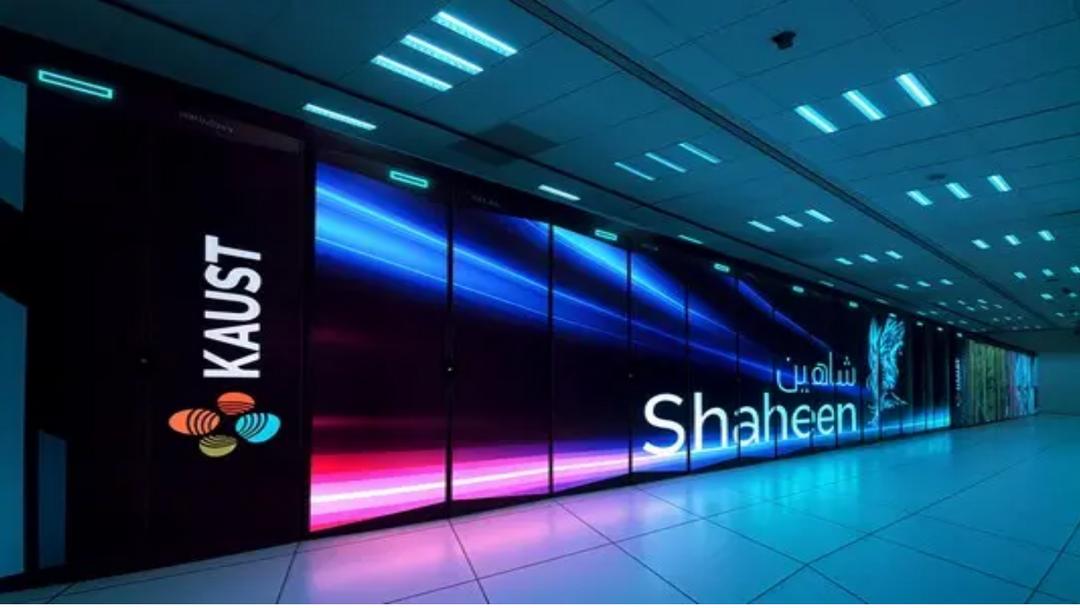
The Shaheen III supercomputer is now the most powerful system in the Middle East, ranking 18th globally on the TOP500. The system anchors KAUST capabilities under Saudi Arabia Vision 2030.
Built on an HPE Cray EX platform with NVIDIA GH200 Grace Hopper Superchips, it boosts research in AI, climate, energy and health. KAUST completed GPU partition acceptance in October 2025 under BIS licence conditions.
The Shaheen III supercomputer will activate its new GPU partition from early 2026, accelerating workloads in Arabic language models, digital twins, remote sensing, automated chemistry and healthcare AI.
Shaheen III supercomputer: What You Need to Know
- The system ranks first in the Middle East and 18th worldwide, strengthening KAUST research aligned with Vision 2030.
- Bitdefender, enterprise grade protection for HPC and research endpoints
- 1Password, secure credential management for research teams
- IDrive, scalable backup for laboratories and data centres
- Tenable, continuous exposure management for complex infrastructures
- EasyDMARC, protect research email domains and reduce spoofing
- Tresorit, encrypted file collaboration for sensitive projects
- Auvik, network visibility and monitoring for campus environments
- Blackbox AI, developer AI assistant for faster model prototyping
Global ranking confirmed at SC25
Announced at SC25 in St. Louis, the Shaheen III supercomputer leads regional high performance computing and places 18th worldwide on the TOP500.
The system uses direct liquid cooled HPE Cray EX architecture with 2,800 NVIDIA GH200 Grace Hopper Superchips. It delivers more than triple the processing power of the CPU based predecessor launched in 2023, setting a new bar for the region.
KAUST completed acceptance and transfer of the GPU partition from HPE in October 2025, meeting U.S. Department of Commerce BIS export licence conditions.
This allows scaled deployment under defined governance and export controls.
Architecture optimised for AI and data intensive science
The platform pairs Grace CPUs and Hopper GPUs with high efficiency liquid cooling, which improves throughput and energy performance for AI training, scientific simulation and inference.
The Shaheen III supercomputer supports complex multi modal models and high fidelity digital twins with faster time to results. For system background, see the HPE Cray EX.
Regional AI initiatives mirror these capabilities. Arabic AI efforts such as customer experience platforms in Arabic illustrate demand for compute that can tailor models to local languages and contexts.
Priority research areas
From early 2026, KAUST will use the Shaheen III supercomputer to advance Saudi Arabia Vision 2030 AI research across national priority domains:
- Arabic centric language models, small and large LLMs adapted to regional linguistics and cultural context
- Digital twin of the Arabian Peninsula, integrated atmospheric, oceanic and terrestrial simulation for climate analysis, spill response and maritime optimisation
- Remote sensing at scale, automated monitoring of wildlife and protected areas, plus decision tools for agriculture and water management for crops such as dates and wheat
- Energy and materials innovation, an automated AIChemist lab operating continuously to discover materials and optimise chemical processes
- Healthcare advances, AI for rare disease diagnosis in the Saudi population, enhanced medical imaging, and autism research with AI and wearables for personalised care
Across Africa and the Middle East, digital transformation programmes are deepening compute needs, from robotic fulfilment centres in Kuwait to 5G deployments that expand data intensive services.
Leadership statements
KAUST leadership said the Shaheen III supercomputer places the Kingdom at the forefront of computation driven discovery.
Professor Sir Edward Byrne, President of KAUST, said the investment empowers researchers to deliver solutions for national and global challenges.
Trish Damkroger of HPE called it a regional milestone that strengthens the global research community. Ian Buck of NVIDIA highlighted efficiency and throughput for climate, energy, healthcare and materials science.
Security and responsible AI operations
Large AI and HPC estates require resilient cyber security and governance to protect data, models and continuity. Operating the Shaheen III supercomputer within clear frameworks reduces risks across advanced AI workflows.
For reference, see guidance on AI cyber threat benchmarks, prompt injection risks in AI systems, and zero trust architecture. Related security concerns have surfaced in the region, including significant AI security flaws that highlight defensive priorities.
Shaheen III supercomputer and Vision 2030 alignment
The Shaheen III supercomputer strengthens the KAUST supercomputer Middle East leadership position and directly supports Saudi Arabia Vision 2030 AI research.
It accelerates research translation across climate resilience, sustainable energy, industrial R&D, precision medicine and national language technologies.
Implications for research, industry and society
Advantages:
The Shaheen III supercomputer expands national capacity to address large scale challenges. It shortens training cycles for Arabic models, supports precise climate and environment simulations, unlocks continuous automated chemistry workflows, and improves population specific healthcare insights.
The platform also attracts global talent and partnerships that amplify research visibility and collaboration.
Considerations:
High performance platforms require sustained funding, specialist skills and robust AI governance. Integrating complex simulations and sensitive clinical data demands strong security, privacy and ethics.
Converting research into deployable solutions needs reliable access, reproducibility standards and inclusive user support across disciplines and institutions.
- Plesk, manage compute hosts and apps at scale
- Passpack, shared password vaults for project teams
- Optery, protect researcher privacy through automated data removals
- MRPeasy, streamline lab supply and production planning
- Foxit PDF, secure document workflows for research outputs
- CloudTalk, scalable voice for distributed research teams
- IDrive, immutable backups for data integrity
- Tenable One, unified risk view across hybrid environments
Conclusion
The Shaheen III supercomputer confirms KAUST leadership in regional high performance computing and AI. It aligns with Vision 2030 priorities and advances mission critical research.
With direct liquid cooling and a powerful GPU partition, the system turns compute into outcomes across language, climate, energy and health. Activation begins from early 2026.
Effective governance, strong security and international collaboration will help the Shaheen III supercomputer deliver lasting scientific and societal impact.
Questions Worth Answering
Where does the system rank globally?
- It ranks 18th worldwide and first in the Middle East on the latest TOP500 list.
What hardware powers the platform?
- An HPE Cray EX system with direct liquid cooling and 2,800 NVIDIA GH200 Grace Hopper Superchips.
When will the GPU partition go live?
- Activation is planned from early 2026 following acceptance in October 2025.
Which research areas are prioritised?
- Arabic centric LLMs, a digital twin of the Arabian Peninsula, remote sensing, automated chemistry and healthcare AI.
How does this support Vision 2030?
- It accelerates national R&D and innovation across AI, sustainability, energy and health, reinforcing strategic goals.
Who are the key collaborators?
- KAUST with HPE and NVIDIA, with performance recognition announced at SC25.
Is cyber security a consideration?
- Yes. Robust security and governance protect data, models and operations across the HPC estate.
About King Abdullah University of Science and Technology (KAUST)
KAUST is a graduate research university in Saudi Arabia focused on science and technology that address global challenges.
The university fosters interdisciplinary work in computing, energy, environment and health to accelerate discovery and translation.
KAUST operates advanced facilities, including the Shaheen series of high performance supercomputers.
About Professor Sir Edward Byrne
Professor Sir Edward Byrne serves as President of KAUST.
He leads a mission to deliver world class research with measurable impact for the Kingdom and beyond.
His leadership supports KAUST contributions to national priorities and international scientific excellence.