

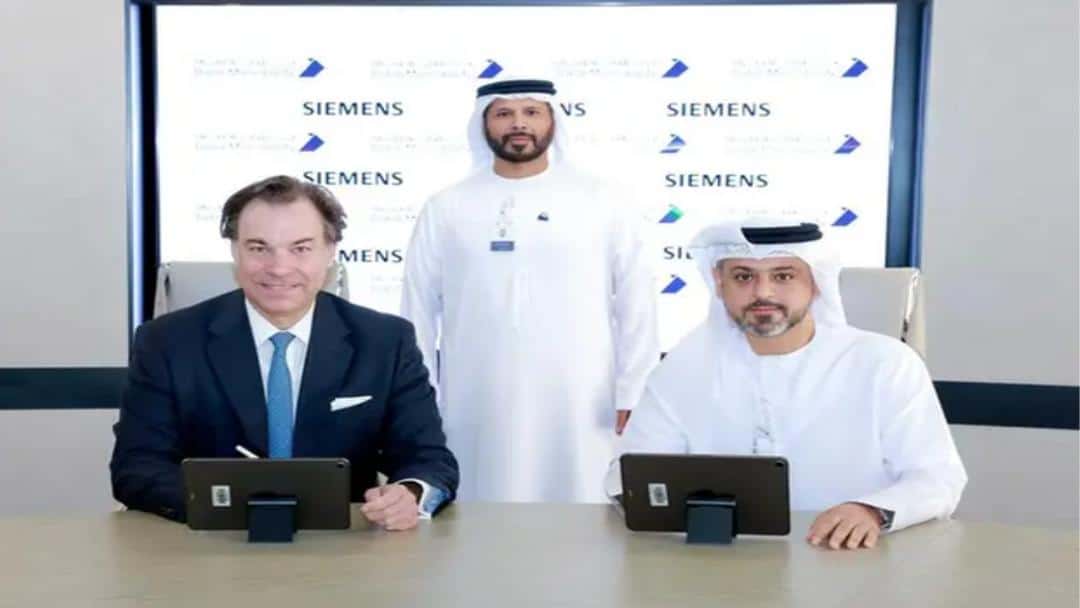
AI integration in Dubai advances as Dubai Municipality signs a strategic MoU with Siemens to embed artificial intelligence in public facilities. The move targets efficiency, sustainability, and digital resilience under D33. It positions the Public Facilities Agency to lead citywide digital transformation.
The agreement will pilot AI and advanced analytics to optimise operations, manage energy, and improve asset performance across parks, beaches, and civic spaces.
Signed by Badr Anwahi of Dubai Municipality and Helmut von Struve of Siemens Middle East and the UAE, the deal focuses on practical deployment, knowledge transfer, and real-time insights.
AI integration in Dubai: What You Need to Know
- Dubai Municipality and Siemens will pilot AI to optimise operations, energy, and service quality across public facilities, aligned with the D33 agenda.
Recommended solutions for secure, scalable AI deployments
- Auvik Network Monitoring: Gain visibility and control across distributed public infrastructure.
- Tenable Vulnerability Management:– Reduce risk across OT and IT assets in real time.
- Bitdefender Security: Protect endpoints powering smart facilities and operations.
AI integration in Dubai: Strategic MoU between Dubai Municipality and Siemens
The Dubai Municipality Siemens partnership establishes a framework to trial Siemens digital platforms across public infrastructure.
AI integration in Dubai aims to enhance facility operations, strengthen energy management, and uplift the city’s digital backbone for resilient services.
AI integration in Dubai aligns with the D33 strategy to build a sustainable, knowledge-led economy.
By embedding AI across public spaces, the Municipality targets measurable gains in service quality, resource optimisation, and long-term asset performance.
What the partnership covers
Within the scope of AI integration in Dubai, the MoU enables pilots and co-development across domains that shape essential services:
- Predictive maintenance systems to anticipate faults, minimise downtime, and extend asset life through data-driven workflows.
- AI-powered building automation to fine-tune safety, comfort, and operations with real-time controls and alerts.
- Energy optimisation to cut consumption, lower emissions, and improve grid-aware facility performance.
- Smart analytics to monitor environmental and operational metrics, enabling instant insight and faster decisions.
- Technical guidelines and knowledge resources to accelerate adoption and embed repeatable best practices.
How the collaboration supports smart city technology in Dubai
The Dubai Municipality Siemens partnership provides applied pilots and standards that can scale across parks, beaches, and civic assets. It advances smart city technology in Dubai with solutions that integrate AI, IoT sensors, and energy platforms without disrupting visitor experience.
The roadmap aligns with broader regional innovation, from CX-focused AI platforms to industrial automation. See related developments in Ghanaian AI innovation and AI-driven customer experience in the region via Arabic AI platforms.
Connectivity uplift, including 5G next-gen networks, further enables scalable deployments.
Operational excellence with measurable outcomes
Through AI integration in Dubai, the Municipality targets institutional readiness and service excellence. Smart analytics and automation will streamline maintenance, reduce waste, and inform lifecycle decisions that maximise asset value.
The Public Facilities Agency’s mandate is reinforced as a key enabler of digital transformation. It will embed structured innovation practices and performance baselines to scale effective solutions.
Security by design for AI-enabled infrastructure
While the MoU prioritises efficiency and sustainability, resilient AI implementation requires strong cybersecurity.
For a wider context, review analyses on AI cyber threat benchmarks, guidance on prompt injection risks, and insights into 5G cybersecurity. Additional coverage of emerging AI risks appears in recent vulnerability research.
AI integration in Dubai will benefit from governance, threat modelling, and security testing across data pipelines, APIs, and edge devices.
Implications for Dubai’s public facilities
Advantages: AI integration in Dubai promises higher uptime, better resource efficiency, and a more consistent user experience.
Predictive maintenance and intelligent controls can lower costs, reduce environmental impact, and deliver measurable service improvements across parks, beaches, and civic assets.
Shared standards and pilots create a repeatable path to scale.
Considerations: Integrating legacy systems, managing change, and upskilling teams require clear governance and metrics.
AI integration in Dubai must prioritise interoperability, data stewardship, and continuous monitoring to maintain resilience and public trust as capabilities expand.
Equip your teams for secure, data-driven operations
- 1Password: Simplify credential security for facility and field teams.
- IDrive Backup: Protect operational data from edge to cloud.
- EasyDMARC: Stop spoofing and secure public service email domains.
Conclusion
By formalising this collaboration, Dubai can test, validate, and scale AI where it delivers the most value in public facilities.
AI integration in Dubai supports D33 by improving services, cutting environmental impact, and elevating operational resilience through data-led decisions.
As outcomes mature, the Dubai Municipality Siemens partnership could become a blueprint for smart city technology in Dubai that prioritises efficiency, security, and community needs.
Questions Worth Answering
What does the MoU enable?
- It sets a framework to pilot AI and digital platforms in public facilities, targeting operations, energy management, and smart analytics under the Dubai Municipality Siemens partnership.
Who signed the agreement?
- Badr Anwahi, CEO of the Public Facilities Agency at Dubai Municipality, and Helmut von Struve, CEO of Siemens Middle East and the UAE.
How does this align with D33?
- It advances D33 by accelerating a sustainable, knowledge-driven economy through smarter, more efficient public infrastructure and AI integration in Dubai.
Which technologies are included?
- Predictive maintenance, AI-powered building automation, energy optimisation, and real-time analytics platforms to enhance service delivery.
What benefits can residents expect?
- Safer, more resilient, higher-quality experiences across parks, beaches, and public spaces enabled by AI integration in Dubai.
Will the partners share best practices?
Yes. They will co-develop technical guidelines and resources to support consistent scaling across assets.
About Siemens
Siemens AG is a global technology company focused on industry, infrastructure, mobility, and healthcare. It combines digital and physical technologies to transform operations.
The company delivers automation, energy, and analytics platforms used across cities and enterprises. Its solutions underpin secure and efficient public services.
In fiscal 2024, Siemens reported €75.9 billion in revenue and around 312,000 employees. It also holds a majority stake in Siemens Healthineers.
About Badr Anwahi
Badr Anwahi is CEO of the Public Facilities Agency at Dubai Municipality. He oversees the design, management, and operation of public spaces.
His remit includes performance, safety, and sustainability across civic assets. He steers digital transformation initiatives with measurable outcomes.
Under his leadership, AI integration in Dubai focuses on resilient, high-quality community experiences supported by data-led operations.
Explore more trusted tools